
China said that after this incident both sides are in communication and coordination on the matter through diplomatic and military channels.

China plans to divert about 200 billion cubic metres of water annually from the Brahmaputra at its highest point, namely the Great Bend, where it turns into India. China's Brahmaputra dam will severely impact India, warns former senior RA&W officer and China expert Jayadeva Ranade.

Addressing party MPs at the general body meeting of the Congress Parliamentary Party in the central hall of Parliament, she said when facing a significant national challenge, it has been the tradition in our country to bring Parliament into confidence.

The talks came a day after the two armies began a limited disengagement in a few areas in Galwan Valley and Hot Spring in a demonstration of their intent to end the row peacefully.

'Clearly, there is a wide gap between the stated intentions of China's top leadership to improve relations with India and the PLA's aggressive border management,' says Brigadier Gurmeet Kanwal (retd).

The defence minister made the remarks after performing 'Shastra Puja' -- the customary worship of weapons -- at the Sukna-based headquarters of the Indian Army's 33 Corps in Darjeeling district of West Bengal on the occasion of Dussehra.

China has started the construction of at least 13 entirely new military positions including three air bases, five permanent air defence positions and five heliports near the Line of Actual Control (LAC) in the aftermath of the Doklam standoff in 2017, according to a report by global security consultancy Stratfor.
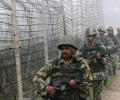
Most of India's reserves for war in the mountains have been sucked in by the standoff with China. A large part of India's airpower has also similarly been committed on the eastern border. By moving these reserves to the China border, India has been weakened vis-a-vis Pakistan. All in all, the nightmare scenario for India of a two-front war may well come true, warns Colonel Anil A Athale (retd).
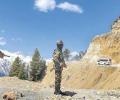
The meeting primarily focused on implementation of certain decisions taken at the fifth round of talks between Corps Commanders of the two armies last week on the disengagement process as well as to bring down prevailing tension in the region, sources said.

He stressed the need for strengthening mutual trust and confidence while seeking solutions to outstanding issues.
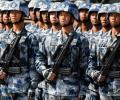
Chinese military has also deployed a sizeable number of its troops in Galwan Valley, the site of the violent clashes on June 15 that left 20 Indian soldiers dead.
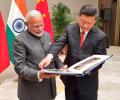
'In South Asia, unlike Southeast, East, or Central Asia, there is a natural hegemon: India. China cannot cast it aside easily'
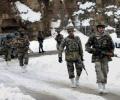
'The Chinese have been moving in step by step; inch by inch for the last 40 years.'

Making a statement in Lok Sabha, Singh also said the Indian Army has inflicted heavy costs including casualties on the Chinese side during the clash with the People's Liberation Army at the Galwan valley on June 15.

Boosting the army's war fighting capabilities along the Line of Actual Control, the government on Wednesday given a go ahead to the creation of a corps including deployment of 50,000 additional troops along the China border at a cost of around Rs 65,000 crore.

The Indian Army will continue to maintain its aggressive posturing in all disputed areas in eastern Ladakh and will not back off till status quo is maintained, sources said.

China has been taking "incremental and tactical actions" to press its claims at the Line of Actual Control (LAC) with India and has unsuccessfully sought to prevent New Delhi from deepening its relationship with the US during and subsequent to the standoff, the Pentagon has said in a major report on China's military modernisation.
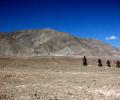
While the de-escalation process was underway, a violent face-off took place on Monday night between Indian and Chinese troops leading to the death of 20 Indian soldiers.
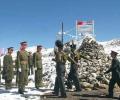
The two sides have already held at least 12 rounds of talks between local commanders and three rounds of talks between major general-rank officials but no positive outcome came out from the discussions, they said.
'India's military posture has become significantly stronger than China's on the 3,500-kilometre Line of Actual Control.' 'This is enhancing confrontation between the two sides,' points out Ajai Shukla.

The Indian troops guarding the nearly 3,500-km Line of Actual Control (LAC) maintained an assertive approach in sync with the broader national security doctrine and procured a variety of military platforms and weapons to enhance their combat capabilities.
Public interest centres on whether the two leaders might make headway in resolving the Sino-Indian boundary dispute.

Chief of defence staff Bipin Rawat on Thursday said the controversy about the Chinese coming into the Indian territory and building a new village is 'not true,' and that the villages were well within the Chinese side of the Line of Actual Control.

The enhancement of combat capability by the two armies in the region came even as both the countries continued their efforts to resolve the dispute through talks at military and diplomatic levels.

The Indian Army has been matching up to the Chinese build up in both Pangong Tso lake and Galwan Valley, the two locations in Ladakh which have witnessed major reinforcement of troops in the last two weeks, sources said. There was very little chance of easing of tension anytime soon as both sides are aggressively holding onto their respective positions, they said.

Until last month more than two-thirds of the Indian Army was deployed against Pakistan. Of 14 army corps, just four-and-a-half faced China, while more than twice that number was ranged against Pakistan.
The US hopes that the differences will be resolved peacefully, officials said in Washington.

Trump on Wednesday said in a tweet that he was "ready, willing and able to mediate" between the two countries.

It is learnt that the India's top military brass is constantly monitoring the evolving situation even as the United States said the aggressive behaviour by Chinese troops was a reminder of the threat posed by China.
Indian military sources said no firearms were used in the clashes and that most of the injuries were sustained following stone-pelting and use of rods by the Chinese side.

In a stern message to its neighbours, China today said it is determined to defend "every inch" of its territory and there was "no room for compromise" with Japan over territorial or historical disputes.
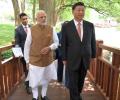
'India's preference today seems to be to exploit the deepening chill in relations with China to breathe new life into its meandering partnership with the US,' argues Ambassador M K Bhadrakumar.

'Neither will China -- at least for now -- because its troops are deployed in equal strength.' 'We are negotiating at equal terms right now and it's a game of patience.'

Tawang wears its history -- and also its present -- with ease. The flourishing town, with restaurants selling everything from noodles to dosas and locals returning home to new business prospects, shows little sign of the tension building up at the border about 40 km away to the north.

'During disengagement, you don't find violence.' 'And that, too, the killing of a commanding officer.' 'This indicates that this is more serious than previous incidents.'
The Indian side also told the Chinese delegation that the talks on disengagement should include Depsang as well as all face-off sites, insisting that it should be a simultaneous process and not a selective one.

'The potential of one such LAC engagement going out of control and leading to heavy casualties cannot be ruled out,' warns Lieutenant General Syed Ata Hasnain (retd).

The Opposition MP pointed to a set of changes taking place in India that had caught the Congress and UPA government off guard, such as a shift from rural to urban.

Just like China wants Trump to lose the US presidential poll, it may want Modi to lose the Lok Sabha polls. So months before the 2024 elections, China may take possession of an important area, say one of the Char Dhams, warns Sanjeev Nayyar.
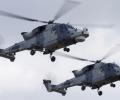
The Indian Air Force is probing the incident, an IAF source said.
 © 2026 Rediff.com - Advertise with us - Disclaimer - Privacy Policy - Sitemap - Feedback - About us - Terms of use - Grievances